


Fire Safety
Fire Ratings
Ceilume's ceiling tiles and panels are fire safe. They have been tested by accredited labs using professional testing standards, and have been shown to have low combustibility, low to average smoke development, and zero to low droplet/particle emission.
In simple terms, Ceilume ceiling tiles and panels do not readily ignite, do not sustain flame easily, don't produce much smoke, don't help spread an active fire, and self-extinguish when the flame source is removed.
Class A
All Ceilume ceiling tiles and panels are Class A rated for surface burning characteristics, flame spread, and smoke development per ASTM E84 - 14 and UL 723, and in accordance with CAN/ULC-S102-10.
A Class A rating is the highest safety classification achievable for building products, and indicates superior resistance to flame spread and reduced smoke development during a fire.
Euroclass B-s20d0 and B-s1-d0
Ceilume's Feather-Light series ceilings tiles and panels are rated B-s2-d0 and Signature series ceiling tiles and panels are rated B-s1-d0 per European standard BS EN 13501-1.
- Warringtonfire Report No. WF 384846 (Feather-Light)
- Warringtonfire Report No. WF 376545 (Signature)
Both ratings indicate that Ceilume ceiling tiles and panels have limited combustibility, little to average smoke generation, and zero to low droplet/particle emission during a fire.
Building Code Requirements
Ceilume ceiling tiles and panels have been evaluated as an interior finish for use as a nonstructural component in approved suspended ceiling framing systems in non-fire-resistance-rated floor-ceiling or roof-ceiling assemblies.
The interior finish classification, thermal stability, and physical properties of the tiles and panels comply with the intent of the provisions of the International Building Code (IBC), International Residential Code (IRC), California Building Code (CBC), California Residential Code (CRC), Florida Building Code - Building (FBC, B), and Florida Building Code - Residential (FBC, R).
Pass-through Fire Sprinklers
Ceilume ceiling tiles and panels can be used with pass-through fire sprinklers. Per Ceilume's installation instructions and IAPMO UES Evaluation Report No. 310, there are three (and only three!) approved methods to install Ceilume ceiling tiles and panels with pass-through fire suppression sprinklers.
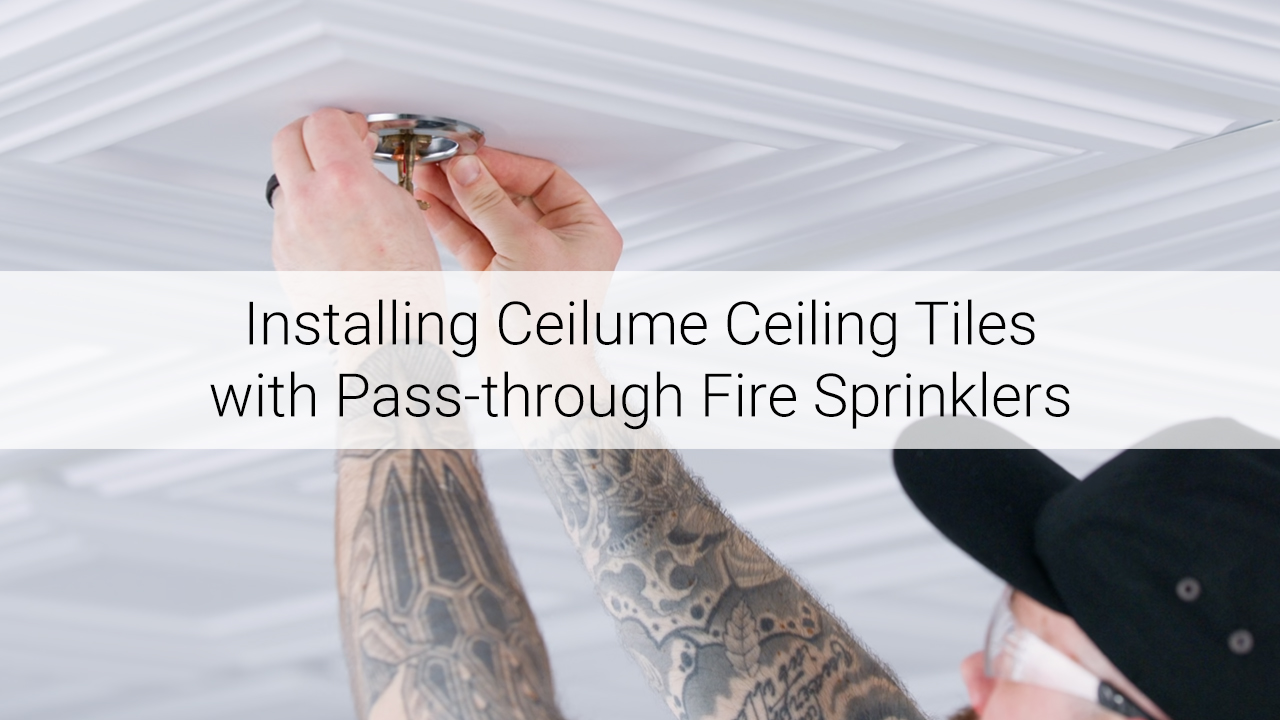
Method 1: Ceiling Tiles with Oversized Holes
IAPMO UES Evaluation Report No. 310 - Section 3.3.3
- Sprinklers shall be located a maximum of 3 inches (76 mm) below the ceiling grid.
- Standard trim rings/escutcheons may be used.
- When trim rings/escutcheons are used, corresponding openings in tiles or panels shall be a minimum of 1/4 inch (6.3 mm) larger than the outer diameter of the trim rings/escutcheons.
- When trim rings/escutcheons are not used, corresponding openings in tiles or panels shall be a minimum of 1/4 inch (6.3 mm) larger in diameter than the sprinkler heads themselves.
Method 2: Refacing Ceiling Tiles with Mineral Fiber Backing Panels
IAPMO UES Evaluation Report No. 310 - Sections 3.3.4 and 3.3.5
- Ceilume's refacing ceiling tiles shall be installed beneath mineral fiber backing panels throughout the entire ceiling or limited to sprinkler penetrations.
- Sprinklers shall be located a maximum of 3 inches (76 mm) below the ceiling grid.
- Standard trim rings/escutcheons may be used.
- When trim rings/escutcheons are used, corresponding openings in tiles or panels shall be 1/4 inch (6.3 mm) smaller than the outer diameter of the trim rings/escutcheons.
- When trim rings/escutcheons are not used, corresponding openings in tiles or panels shall be a minimum of 1/4 inch (6.3 mm) larger in diameter than the sprinkler heads themselves.
Method 3: Stack of Three Signature Ceiling Tiles
IAPMO UES Evaluation Report No. 310 - Sections 3.3.4 and 3.3.5
- At sprinkler penetrations, a stack of three of Ceilume's Signature series ceiling tiles or panels shall be installed together in one space.
- Sprinklers shall be located a maximum of 3 inches (76 mm) below the ceiling grid.
- Standard trim rings/escutcheons may be used.
- When trim rings/escutcheons are used, corresponding openings in tiles or panels shall be 1/4 inch (6.3 mm) smaller than the outer diameter of the trim rings/escutcheons.
- When trim rings/escutcheons are not used, corresponding openings in tiles or panels shall be a minimum of 1/4 inch (6.3 mm) larger in diameter than the sprinkler heads themselves.
Important Note About Insulation
Insulation, including Soniguard Drop Ceiling Insulation, may not be installed above ceiling tiles or panels at sprinkler penetration locations.
Drop-out Ceiling Tiles and Panels
Ceilume's Feather-Light series ceiling tiles and panels are rated, listed, and approved for installation beneath fire sprinklers in drop-out (sometimes called "drop-away," "melt-out," or "melt-away") ceiling installations.
When exposed to heat from a developing fire, drop-out ceiling panels soften, distort, and fall from the ceiling grid. Heat from the growing fire activates the sprinkler which, unimpeded by the panels, controls or extinguishes the fire.
- See Drop-out Ceilings for more information.
